Autism Spectrum Disorder

WHAT is the Autism spectrum disorder?
The neurological and developmental condition known as autism spectrum disorder has an impact on a person’s behavior, learning, communication, and social interactions. Autism is referred to as a “developmental disorder” since symptoms typically manifest in the first two years of life, even though a diagnosis can be made at any age.
Communication problems and poor social functioning are the main characteristics of autism spectrum disorder (ASD), a group of neurodevelopmental disorders. Intense concentration on a single object, inability to respond, a lack of awareness of social cues (such as body language or tone of voice), repetitive motions, or self-abusive behavior like head-banging are other symptoms.
Autism is a complicated disorder that typically impacts people for the rest of their lives. Social skills, communication, relationships, and self-regulation are all known to be impacted by autism.
Autism Spectrum Disorder symptoms:
Early on in the developing process, symptoms must be present. Signs typically appear in children between the ages of 2 and 3 years old.
What are the 3 main symptoms of autism spectrum disorder?
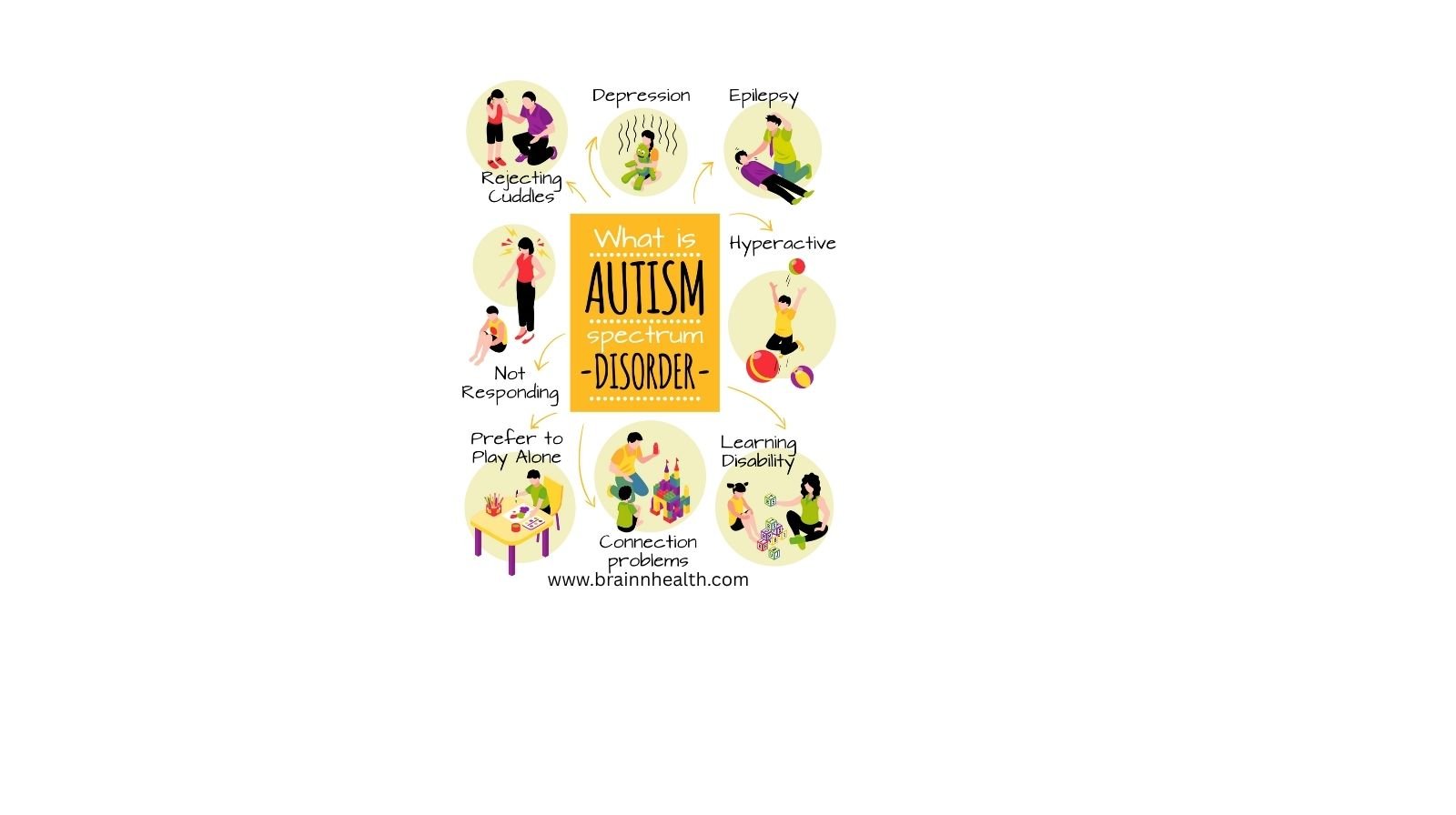
- Differences in social and communicative behaviors, intellectual difficulties, and other physical and mental health concerns are just a few of the many symptoms that people with autism may experience. Individuals with autism also require a variety of services and health care. According to research, early access to necessary services and supports can lead to improved health and well-being in the long run. Here are some symptoms of autism spectrum disorder.
- Deficits in social-emotional reciprocity, for example, from abnormal social approach and failure of normal back-and-forth conversation; reduced sharing of interest, emotion, or affect; to failure to initiate or respond to social interactions.
- Deficits in nonverbal communicative behaviors used for social interaction, for example, poorly integrated verbal and nonverbal communication, abnormalities in eye contact and body language, abnormal gestures, and a total lack of facial expression.
- Stereotypes or repetitive motor movements, use of objects, motor stereotypes like lining up toys or flipping objects, are highly restricted, fixated interests that are abnormal in intensity or focus.
- Hyper-or hyperactivity to sensory input or unusual interest in sensory aspects of the environment, like apparent indifference to pain/temperature, adverse response to sound or textures, excessive smelling or touching of objects, visual fascination with lights or movements.
People with autism may also suffer from other illnesses.
People with autism frequently have additional conditions, such as:
ADHD stands for attention-deficit hyperactivity disorder.
anxiety, sadness, epilepsy, and dyslexia
Risk factors:
The best established risk factor for individual outcome within an autism spectrum disorder is the presence or absence of associated intellectual disability and language impairment, and additional mental health problems. Epilepsy, as a chronic diagnosis, is linked to a higher level of intellectual disability and a lower level of linguistic ability.
-
Environmental:
A variety of nonspecific risk factors, such as advanced parental age, low birth weight, or fetal exposure to valproate, may contribute to the risk of autism spectrum disorder.
-
Genetic and physiological:
Heritability estimates for autism spectrum disorder have ranged from 37% to higher than 90% based on twin concordance rates. Currently, as many as 15% of cases of autism spectrum disorder appear to be associated with non-genetic mutation; however, even when an autism spectrum disorder is associated with a known genetic mutation, it does not appear to be fully penetrant.
Prevalence:
In recent years, reported frequencies for autism spectrum disorder across the US and non-US countries have approached 1%of the population, with similar estimates in child and adult samples.
Causes of autism spectrum disorder:
What are the 3 main causes of autism spectrum disorder?
- Autism spectrum disease appears to be influenced by several genes. Rett syndrome or fragile X syndrome are two examples of genetic conditions that may be linked to autism spectrum disorder in certain children. Other children may be more susceptible to autism spectrum disorder due to genetic alterations, commonly referred to as mutations. Other genes might also influence how brain cells communicate or how the brain grows. Or the severity of symptoms may be influenced by certain genes. Certain genetic alterations appear to be inherited, whereas others are not.
- Environmental elements. Researchers are investigating the potential links between autism spectrum disorder and conditions such as air pollution, medications, viral infections, and pregnancy difficulties.

Treatment of Autism spectrum disorder:
A child can be helped to realize their full potential through several successful interventions:
-
Applied behavioral analysis:
In order to develop a structured behavioral plan for enhancing the child’s adaptive abilities and reducing inappropriate conduct, applied behavioral analysis includes a methodical examination of the child’s functional problems.
-
Training in social skills:
This intervention, which can be used in both group and individual settings, helps kids with autism become more adept at interacting with others.
- Speech and language therapy: Can enhance a child’s linguistic comprehension and speech habits.
-
Occupational therapy:
Can help with handwriting issues and deficiencies in adaptive abilities related to everyday life tasks.
-
Training in parent management:
Effective strategies for handling problematic behavior and promoting proper behavior in children are taught to parents. Parent support groups assist parents in managing the challenges of parenting an autistic child.
-
Services for special education:
Are offered by schools as part of an individualized education plan, and they may cover a variety of services and accommodations for repeated behaviors, limited interests, and social communication deficiencies. For very young children, this may involve special classes that address language, social skills, and other requirements.
-
Handling situations that co-occur:
Compared to their classmates without autism, children with autism are more likely to suffer from insomnia, attention-deficit/hyperactivity disorder (ADHD), intellectual impairment, anxiety, and depression. It is also necessary to address these conditions. Any of the treatments mentioned above, along with psychotherapy and/or medication, might lessen the impact of these disorders. Coordination with a pediatrician or primary care physician is usually required for the treatment of these disorders.
-
Medication:
If necessary, a child psychiatrist can prescribe medication after conducting an evaluation for additional mental health issues. For instance, drugs like aripiprazole and risperidone—the two drugs approved by the Food and Drug Administration for irritability associated with autism—can be used to lessen autism-related irritability that does not improve with behavioral interventions. These drugs should be prescribed sparingly by a qualified clinician working with the child’s parents.
Autism spectrum disorder research on stem cell therapy in Pakistan:
Nevertheless, the majority of individuals with autism frequently experience lifelong difficulties with the disorder. Treatment for the illness is challenging. Recent studies are starting to suggest that stem cell therapy could be a helpful treatment option for individuals with autism.
It is a fact that some Pakistani institutions, including the IRM Hospital in Islamabad, are offering this stem cell therapy as an experimental treatment for ASD. Both clinical and research, as to whether stem cell treatment will help with brain function and associated symptoms are still being performed. Stem cell therapy is not a cure for ASD, but it is exploring new territories and pending research that needs to be considered with caution when dealing with unproven evidence.
Understanding of Stem Cell Therapy For Autism Spectrum Disorder (ASD):
Experimental Treatment:
It is important to realize that treating ASD with stem cells is not an established cure and remains to be tested as a experimental treatment.
Possible Benefits:
The power of stem cell therapy is considered to enable beneficial influences on healthy brain development as well as recovery of communication, social interaction and repetitive behaviors in ASD.
Mechanism:
Stem cells can become many types of cells, and it is hypothesized that they might be able to support neurological functions or replace damaged neurons.
Crucial Points to Remember:
Watch Out for False Information:
Clinics that promise a cure-all treatment or guaranteed gains should be avoided.
Focus on Peer-Reviewed Research:
To find evidence-based information, look for peer-reviewed journals, which are where real research is published. You can do this by using resources like PubMed or Google Scholar.
Seek Advice from Medical Professionals:
For a precise diagnosis and to go over the possible advantages and disadvantages of any suggested treatment, always seek advice from licensed medical professionals.