


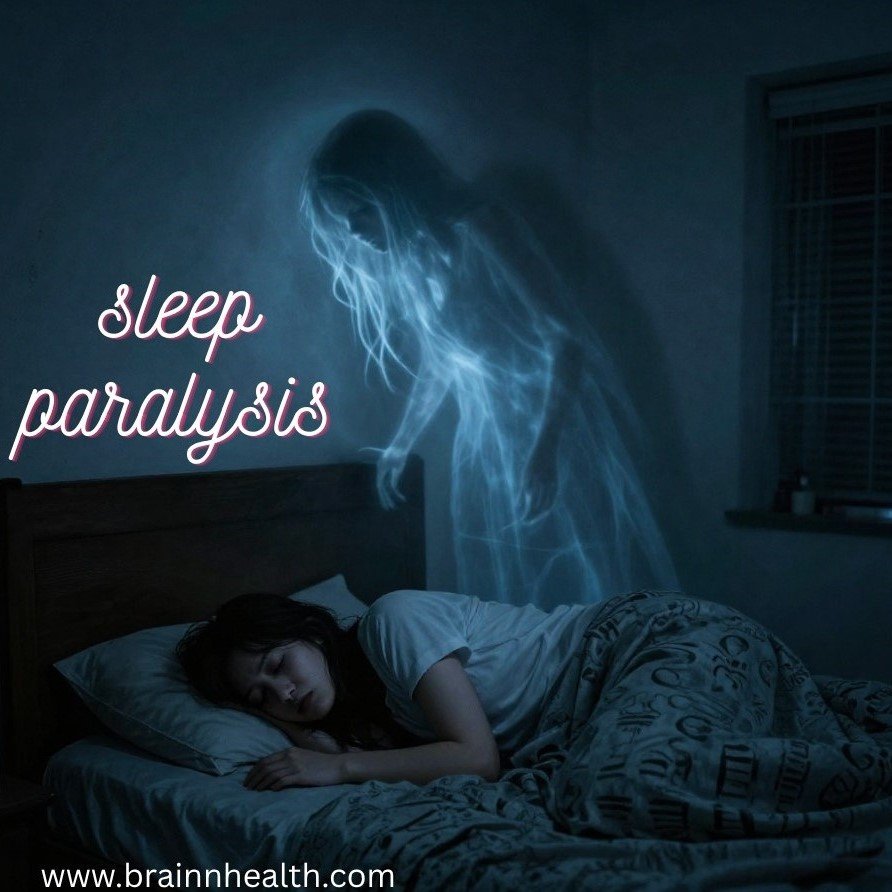
Sleep paralysis
The phenomenon known as “sleep paralysis” happens when a patient resumes consciousness while maintaining muscle Antonia during REM (rapid eye movement) sleep. This causes the patient to experience extreme terror and anxiety as they lie awake and are unable to use any portion of their body.
Overview:
What is sleep paralysis?
The inability to move any portion of your body either before you go to sleep or when you wake up is known as sleep paralysis. It occurs while your body is transitioning between wakefulness and sleep. An episode is fleeting, lasting anything from a few seconds to a few minutes.It is a kind of sleep disorder.
It often comes with visual hallucinations of the incubus and intruder types. The perception of a threatening person or presence in the room is known as an intruder hallucination. The hallucination of feeling pressure on the thorax while engaging in violent or sexual behaviors is the hallmark of the Incubus phenomenon. Feelings of suffocation, paralysis, and anxiousness are often present.
It typically appears during the REM sleep phase of the sleep cycle. While sympathetic tone increases during phasic REM sleep, parasympathetic tone increases, and sympathetic tone decreases during non-REM sleep. It momentarily paralyzes the body’s muscles and stops bodily parts from moving in reaction to dreams. The disconnect between perception and motor control that characterizes sleep paralysis is created if the patient attains awareness in this state.
During a sleep paralysis episode, you will probably experience fear or anxiety. You might feel perplexed when it is over because you will be able to move your body normally again. You may become anxious about sleeping after just one instance of sleep paralysis. This may have an impact on your mood and daytime functioning.
Is sleep paralysis harmful?
Although sleep paralysis is not harmful, an episode may be emotionally upsetting. Inform a healthcare professional if you are having trouble sleeping because some episodes of sleep paralysis are linked to other sleep disorders.
What are the symptoms of sleep paralysis?
Your arms and legs are immobile.
• You are unable to speak.
• Feelings of being forced out of your body or of pressure against your chest (suffocation).
• Hallucinations (such as the feeling that someone hazardous is in your room).
• Drowsiness during the day.
What is that feeling of sleep paralysis?
You are conscious of your surroundings during a sleep paralysis episode, but you are unable to move or talk. You are still able to breathe and move your eyes. You might experience:
• Terror
• Fear of the unknown.
• Being powerless.
What is the duration of sleep paralysis?
A sleep paralysis episode might last anywhere from a few minutes to several hours. It can go on for a few seconds or twenty minutes. Usually, it lasts only a few minutes.
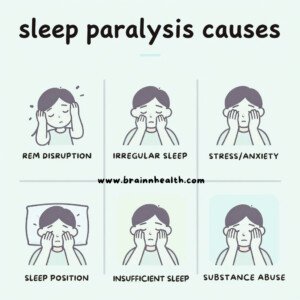
Numerous factors have been identified to have some degree of correlation with sleep paralysis, although studies have not shown a direct causal relationship between a risk factor and the condition. These include a family history of sleep paralysis, alcohol intake, anxiety disorders, poor sleep quality, exposure to traumatic events, substance use disorder, and obstructive sleep apnea. Numerous investigations have found a familial association, which suggests that this illness may have a hereditary tendency.
Prevalence:
It is estimated that 7.6% of the general population suffers from sleep paralysis. This disorder is slightly less common in men than in women. Although sleep paralysis can start at any age, the first signs typically appear in childhood, adolescence, or early adulthood. Episodes of sleep paralysis may become more common in later decades after beginning in adolescence. There is a greater prevalence of another mental disease among patients and students.Moreover, evidence indicates that individuals of non-white ethnicity exhibit a greater incidence of sleep paralysis.
Pathophysiology:
Incubus hallucinations during sleep paralysis episodes may be elucidated by a reduction in respiratory muscle activity during REM sleep, attributable to motor neuron inhibition. During REM sleep, skeletal muscles become weak and breathing becomes irregular. This greatly reduces tidal volume and alveolar ventilation, which leads to hypercapnia. In healthy people, alveolar ventilation can be 40% lower during REM sleep than when they are awake.
Hypervigilance is another part of REM sleep, and it seems to start in the midbrain. This hypervigilance is what makes people feel scared and paranoid during these episodes. A flaw in the brain stem’s structures may be responsible for REM sleep problem.
Physical and chronological:
People who have sleep paralysis say it happens before they fall asleep, when they wake up, and both times. Before the episodes, the majority of patients indicate particular stressful occurrences, modifications in their professional and personal timetables, or an emotional experience. During an episode, a physical exam may show all the signs of REM sleep, such as rapid eye movement, muscle Antonia, less activity in the respiratory muscles, and a faster heart rate.
Management and Treatment
Sleep paralysis during an active episode has not yet been directly treated. There is currently no treatment to stop an episode, although efforts have been undertaken to control the underlying psychological and physical conditions that cause an episode. As a direct treatment for sleep paralysis, Focused-Attention Meditation Combined with Muscle Relaxation (MR Therapy) showed some therapeutic improvement in one research.
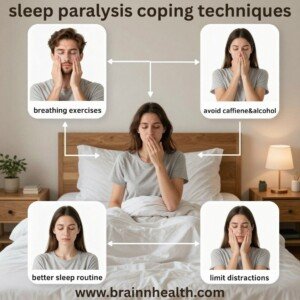
In sleep paralysis, improving sleep hygiene is a typical strategy to help prevent it because there is a strong association between it and other sleep issues. A person’s daily routines and behaviors that affect the quality of their sleep are referred to as sleep hygiene. For instance:
• Weekends included, a set sleep routine (going to bed and waking up in the morning).
• There should be a cozy mattress and a cushion in the bedroom.
• A bedroom with minimal light and noise intrusion.
• Avoid watching TV in the bedroom and stick to a predetermined pre-bed regimen.
• Reduce your intake of alcohol and caffeine, particularly at night.
• Before going to bed, avoid using any electronics, including cell phones, for at least 30 minutes.
• Using drugs that stop you from falling asleep at the REM stage.
• Taking drugs (such as antidepressants) to treat a sleep disturbance or underlying mental health issue.
Patient education and deterrence:
Patients need to know that having sleep paralysis alone is not dangerous. Doctors should tell their patients to use medicine and meditation to help them deal with their anxiety. Patients need to understand the hallucinations that happen during these episodes as well.
Patients need to know in sleep paralysis what causes, what kind of, and what these hallucinations mean because they often make people very anxious and upset. Patients will not begin to alleviate their fear of sleep paralysis until they fully understand its pathogenesis and its limited consequences, which will enhance their prognosis.
A story based on sleep paralysis:
The only sound in the room came from the clock. Maya was in bed with her eyes wide open, staring at the ceiling. When she suddenly woke up, she couldn’t move. It looked like there was something heavy on her coffin that she couldn’t see. Fear started to build up in her throat. She tried to scream, but nothing came out.
She saw a shadow move near the entrance out of the corner of her eye. It looked like it was breathing and moving like a bank, and it was darker than the rest of the room. It came closer and closer, and with each turn, it seemed like it would never end. Maya’s body was strong, but her heart was weak. The shadow bent over her, and even though it didn’t have a face, she could feel it’s cold, knowing wave.
It also ended just as suddenly as it had started. As her fritters jerked, air shot back into her lungs. The room was calm, quiet, and normal, just like it had been before she sat up and started to breathe heavily. But she could still feel that horrible thing on her skin. She was sure it wasn’t a dream. There was no way. Every night, she was scared to close her eyes. Not because it was dark, but because she was scared of waking up and being stuck again.



10 Most Common Mental Illnesses - brainnhealth.com
[…] that affects a person’s thoughts, emotions, and actions. The result may be a combination of hallucinations, delusions, and disordered thoughts and behavior. Hearing voices or seeing visuals that other […]